From Control to System Design: The Future of Delivery Leadership
Calendars full. Meetings constant. Progress slow.
Calendars full. Meetings constant. Progress slow.
If that's the pattern in your organisation, the instinct is usually to push harder. Add a steerco. Tighten the deadline. Escalate the risk. Get the senior leader into the room.
It's the muscle memory of a generation of delivery leaders who came up in a simpler era. And in most modern organisations, it no longer works.
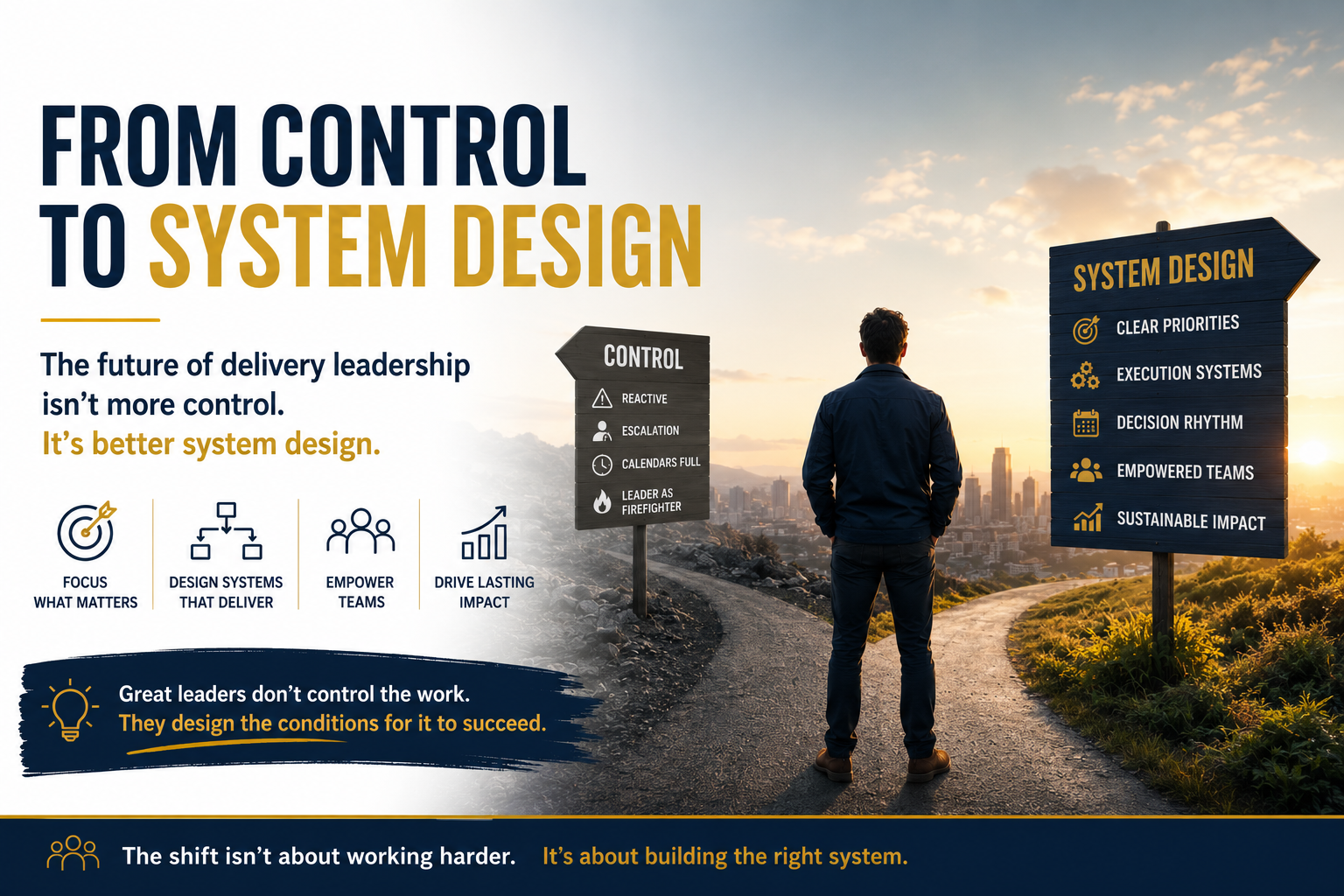
Busy is not momentum. The future of delivery leadership isn't more control. It's better system design.
The leadership style most of us inherited
Traditional delivery leadership was built around control.
Deadlines and pressure. Personal intervention when things went wrong. The senior leader as the firefighter — the person who jumped on the call, broke the deadlock, escalated to the right executive, and got the train back on the rails.
That model worked when organisations were simpler. Fewer dependencies. Slower clock-speeds. A handful of strategic initiatives, not forty in flight at once. A senior leader could plausibly hold the whole picture in their head and step in where it mattered.
Today most environments are too complex for constant intervention. The variables outpace any one person's attention. By the time a leader has bounced between three escalations, four steercos and a crisis from another portfolio, the issue they were trying to fix has already mutated.
Control doesn't scale. The leaders who keep relying on it end up as the bottleneck they were hired to remove.
Everything is Priority 1 — and why that's a system signal
Look at where the control model breaks first, and you find the same conversation everywhere: "everything is priority one."
It's tempting to position every initiative as critical. Every stakeholder has a valid reason. Every piece of work matters to someone. So the portfolio swells, intervention escalates, and the leadership team spends its days juggling rather than deciding.
But the system can't support it all at once. So what actually happens?
- Work gets spread thin.
- Context switching multiplies.
- Progress slows down across the board.
- Quick asks pile up — and unplanned work quietly kills the planned work.
It doesn't feel like de-prioritisation. It feels like momentum disappearing.
The organisations that move fastest are usually the ones doing less. Not because they lack ambition — because they make trade-offs explicit. When this is working well, fewer things are in flight, work actually finishes, and leaders spend less time juggling.
That isn't a leadership willpower problem. It's a system design problem. And it's the first signal that an organisation is asking the wrong question of its delivery leaders.
What modern delivery leadership actually looks like
The shift I'm seeing in the leadership teams that consistently deliver is subtle but decisive. They've stopped trying to control the work and started designing the conditions in which good work can happen.
Practically, that means investing in four things.
Prioritisation discipline. A clear, force-ranked view of what matters most this quarter — and the discipline to say no to the things that don't. Not as a one-off exercise, but as a standing rhythm. Teams know what's at the top, what's been parked, and why.
Execution systems. Visible flow. Clear ownership. WIP limits that mean something. The plumbing that lets work move from intent to outcome without a senior leader having to chaperone each handoff.
Clear decision cadence. Decisions made on a known clock — not whenever the next escalation lands. Steercos that decide rather than report. Forums where trade-offs happen by default, not by exception.
Teams that aren't running on adrenaline. Calendars with room to think.
Instead of diving into every problem, leaders design environments where good decisions and effective work can happen consistently. The senior leader's role shifts from firefighter to architect.
High-performing teams don't magically emerge by accident. They're almost always the result of thoughtful system design.
The shift in your own week
You can feel the difference in your own diary.
Control-mode delivery leadership shows up as a calendar wall-to-wall with steercos, escalations and one-on-ones. Most of the day is reactive. Most of the week answering questions that should have been answered by the system.
System-design delivery leadership shows up as fewer meetings, sharper ones, and visible blocks for thinking and design work. The leader is no longer the throughput constraint. The system is doing more of the lifting.
If your week looks closer to the first picture than the second, that isn't a personal failing. It's a signal that the system underneath you needs design attention. The good news: that's leadership work you can start on Monday.
Pick one place where you're currently the bottleneck — a recurring escalation, a decision that always comes back to you, a handoff that only works when you're in the room. Treat it as a system to redesign, not a fire to keep fighting.
That's where the next generation of delivery leadership is heading. Less heroics. More design.
Coincidentally, this is also the lens we'll be exploring at upcoming The Curve x EPiC roundtables in Leeds and Sheffield — looking at AI transformation through the lens of organisational readiness, execution systems and leadership alignment, rather than just tooling and hype.
Because in practice, AI maturity is often a reflection of organisational maturity.
Register for the Leeds or Sheffield roundtable →
Will Thompson is Managing Director UK at EPiC Agile, working with leadership teams on transformation, operating model and execution at scale across the UK and Europe.
If you're rethinking how delivery leadership works in your organisation, get in touch with the EPiC UK team — we run honest, vendor-noise-free conversations about what it actually takes to deliver.
Get the Operator Brief
A short fortnightly email for people who run things — one idea, one practical tool, one lesson from the field. No fluff.
Explore More Insights
Discover more lessons from the trenches of agile transformation.
View All Articles