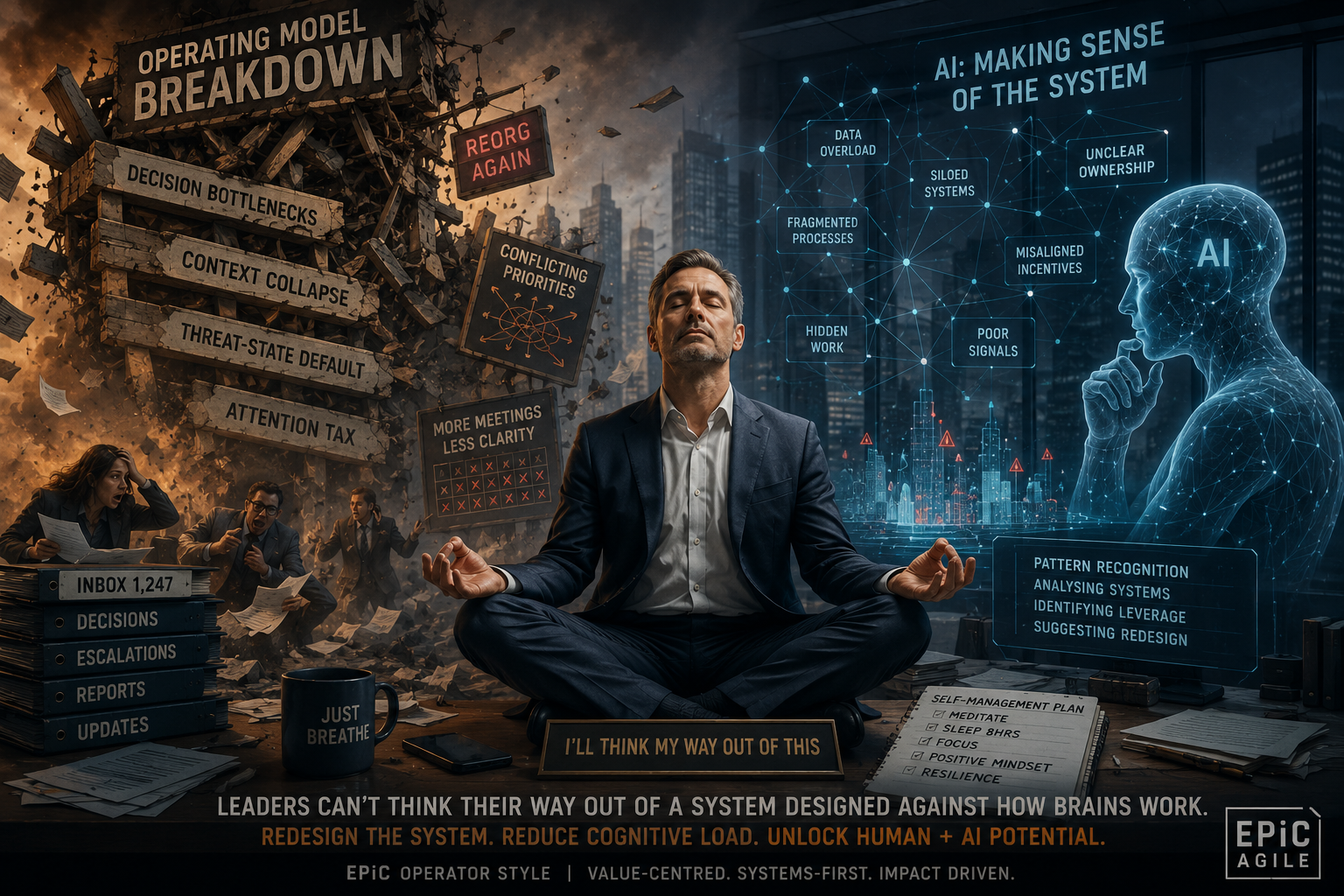
Cognitive Load Is an Operating Model Problem: Designing AI-Ready Organisations Around How Brains Actually Work
Neuroscience is having a moment in leadership. But mindset alone won't fix a structurally overloaded organisation — and AI is making the gap impossible to ignore.
The neuroscience trend everyone is repeating — and the org-design piece almost no one is talking about
Open any serious leadership publication right now and you'll find the same essay rewritten with different fonts. Neuroscience is fashionable again. SCARF is having its third comeback. Executives are being told to "build cognitive self-awareness as rigorously as financial acumen", to manage their attention like a portfolio, to become "scientists of their own brain".
All of it is true. Some of it is even useful.
But it stops short of the thing that actually matters when you're trying to lead a 5,000-person business through AI adoption: the org itself is a nervous system, and most of them are designed to fail under load.
You can teach an executive every trick in the cognitive-regulation book. You can hand them their SCARF profile, train them on box breathing, get them sleeping eight hours and meditating at six. None of it survives contact with an operating model that funnels 47 decisions per week through their inbox, fragments their attention across nine reporting lines, and rewards busyness over judgement.
This is the gap in the current conversation.
Leaders are being asked to rewire themselves while sitting inside organisations explicitly designed against how their brains work.
This is about closing that gap.
Why "rewire the leader" fails without rewiring the operating model
David Rock's SCARF model — Status, Certainty, Autonomy, Relatedness, Fairness — was published in 2008 as a way to predict when social interactions would tip the brain into threat response. The model is sound. The implementation advice is usually wrong.
Most leadership programmes use SCARF as a self-management tool: here's how to spot when you're triggered, here's what to do about it. That treatment is necessary. It is also where the work usually stops, and where the value usually evaporates.
Because SCARF is not really an individual model. It's a description of what an organisation does to people every day, at scale, by design.
A matrix structure that splits accountability across three reporting lines? That's a permanent Autonomy hit. Annual restructures that drop in via Friday email? A standing Certainty threat. A performance system where two teams chase the same OKR and one is told to "collaborate" with the other? Status and Fairness, in stereo. AI rollouts where staff are told their work will change but not how? All five at once.
You can put the executive on a neuroscience retreat. You cannot retreat your way out of a structure that produces this much friction at this much velocity. The friction is the structure.
Generative AI didn't create this problem — it made it impossible to ignore
AI compresses decision cycles, surfaces ambiguity, accelerates the rate at which the organisation has to reconfigure itself. Every weakness in the operating model — every spot where cognitive load was already being dumped on humans — now shows up faster and at higher amplitude.
So the question for any executive serious about AI-era leadership isn't how do I become a more resilient operator inside this system. It's how do I redesign the system so it stops generating the problem in the first place?
The Four Cognitive Failure Modes of AI-era org design
After two decades of working inside transformations across Australia, the UK, the US and Canada — banks, super funds, government, healthcare, energy — four patterns keep showing up. We call them the Four Cognitive Failure Modes, and they are the operating-model symptoms that neuroscience predicts will fail under AI-era load.
1. Decision Bottleneck
Authority is concentrated higher up the org than the information is. Leaders are forced to decide on things they don't have working knowledge of, while the people who do have the knowledge are stuck waiting. Cognitively, this is a sustained Autonomy threat for the people who know, and Certainty exhaustion for the people who decide. AI multiplies the volume of decisions, which means a bottleneck that was tolerable in 2020 becomes a breakdown in 2026.
2. Context Collapse
The structure splits a single value stream — onboarding a customer, getting a product to market, processing a claim — across so many functions, ceremonies and handoffs that no one can hold the whole picture. Brains pattern-match poorly when context is missing, so people default to local optimisation. AI tooling accelerates each fragment without reassembling the whole, which makes the collapse worse.
3. Threat-State Default
The org has so much background hum of restructure, reorg, "transformation" and AI-driven uncertainty that the median employee operates from a low-grade threat state most of the time. Threat state narrows attention, kills creativity, and degrades the exact higher-order thinking AI is supposed to free us up for. Worse, threat state is contagious — it propagates fastest through the formal reporting line.
4. Attention Tax
The structure levies an attention cost on every productive minute. Slack, email, six-platform tool sprawl, meeting culture that fills every gap, and an emerging layer of AI agents pinging humans for confirmation. The brain's prefrontal cortex — the bit doing the high-value judgement work — can only sustain around 90 minutes of deep focus a day under good conditions. Most operating models systematically prevent those 90 minutes from existing.
You cannot mindfulness your way out of any of these. They are structural. They have to be redesigned at the operating-model layer.
Value-Centred Design: an operating model that respects how brains work
This is the part of the conversation almost no one is having, and it's where EPiC plants its flag.
Value-Centred Design (VCD) is our framework for redesigning operating models around customer value flow rather than functional convenience. The premise is simple: organise the work, the teams and the decision rights around the value the customer exchanges with you, not the org chart that history left you.
VCD wasn't built as a neuroscience framework. It was built to make value flow faster. But when you put it next to the Four Failure Modes, the alignment is uncomfortably clean:
- Crews replace silos. A crew is a long-lived, cross-functional unit that owns an end-to-end slice of value. It collapses handoffs, restores context, and gives the brain something it craves: a complete map. Goodbye Context Collapse.
- Decision rights move to the work. VCD pushes authority to the level where the information lives. Leaders decide what the crew can't; the crew decides everything else. Autonomy restored. Decision Bottleneck dissolved.
- Cadence beats reorg. VCD replaces the annual restructure with quarterly value reviews and continuous evolution. Change becomes a regular, predictable rhythm rather than a periodic shock. Certainty restored. Threat-State Default replaced with steady-state adaptation.
- Focus is a designed asset, not a personal virtue. VCD ringfences focus time at the crew level — protected stretches where the work is the work and the platform isn't. AI agents are wired in as augmentation inside the crew's flow, not as another interrupt on the human's attention. Attention Tax cut at the source.
This is what we mean when we say cognitive load is an operating model problem. The leverage isn't at the individual. It's in the design.
Four partner perspectives: what we're seeing across AU, UK and the Americas
EPiC operates across three regions. The shape of the problem is the same; the local pressure points differ. Here's what each of our partners is seeing on the ground.
Brad Bennett, Founder
"After two decades of this work I've stopped being surprised by how often the answer to a 'people problem' is structural. Burnout in the executive team isn't a wellness issue — it's almost always an operating-model issue we haven't named yet. AI is going to expose every one of those unnamed issues at the same time. The firms that thrive in 2026 are the ones who treat operating-model redesign as a leadership discipline, not a project."
Rob Gaunt, Co-Founder (Australia)
"In Australian banking and super we're watching boards demand AI strategy from executive teams who are already cognitively overextended by the regulatory load. You can see the gap close-up: leaders are being asked to make AI-era decisions inside a 2010-era operating model. Every conversation I have lately ends up at the same place — we need to redesign the org before we scale the AI, not after."
Will Thompson, Managing Director UK
"In the UK there's a sharper edge to it. Cost pressure is forcing operating-model questions that would have been theoretical a year ago. The honest version is that most firms can't afford their current operating model and can't yet operate the AI-augmented version either. Bridging that gap is a structural design challenge, not a communications exercise. The leaders getting this right are simplifying complexity, increasing clarity, and enabling smaller teams to deliver more meaningful value."
Ron Laudadio, Managing Director EPiC Americas
"What I'm seeing across North America is leadership teams over-investing in AI tooling and under-investing in the org changes that make the tooling pay off. The neuroscience piece is real — but it lands wrong if you treat it as a personal-development exercise. The leaders who'll win the next five years are the ones who redesign decision rights, redesign their systems of work and redesign cadence. Mindset training without that isn't real."
A composite case: what this looks like in practice
A mid-size Australian financial services firm — call them Cohort — came to us in late 2024 with a familiar brief: "We need an AI strategy." What we actually found inside was the Four Failure Modes running at full volume.
Decisions on AI use cases were stacked seven-deep in the COO's inbox. The Operations function and the Digital function were each running independent AI pilots, neither aware of the other. Quarterly restructures had become annual restructures had become almost-monthly restructures. The exec team described themselves, unprompted, as "exhausted before the AI work even starts".
We didn't lead with AI. We led with a Value-Centred redesign of the customer-onboarding stream — the value stream that was most under load. Five crews, end-to-end ownership, decision rights pushed two levels down, a quarterly value-review cadence replacing the rolling restructure.
Eight months in: the onboarding stream's cycle time dropped 38%. Voluntary attrition in the affected teams halved. The COO's decision queue shrank by two-thirds. Then — and only then — we layered the AI work in, this time as crew-level augmentation rather than enterprise-wide rollout. Adoption was nearly frictionless because the cognitive headroom was already there.
The lesson isn't that VCD is magic. The lesson is that you can't bolt AI onto a cognitively overloaded operating model and expect it to land. You have to clear the load first.
Cohort is a composite case drawn from multiple EPiC Agile engagements; details have been anonymised.
The AI-Ready Operating Model Diagnostic
We've turned the Four Failure Modes into a 25-question diagnostic that any leadership team can run on their own organisation in under 30 minutes. It scores you across the four modes and surfaces the operating-model gaps most likely to break under AI-era load.
Ten of the questions appear below as a self-check. The full version, with scoring, benchmarks and a remediation guide, is a free download.
Decision Bottleneck
- Can a senior leader name three decisions in the last fortnight that should have been made two levels below them?
- Is the average time from decision-needed to decision-made trending up, flat, or down over the past 12 months?
- Are leaders making more first-time decisions, or repeating the same ones?
Context Collapse 4. Can any single person in the org draw the end-to-end flow of your top three customer journeys? 5. How many handoffs sit between a customer request and a customer outcome? 6. Are your AI pilots owned at the functional level or the value-stream level?
Threat-State Default 7. When did the last organisational structure change happen — and was it announced as "the last one"? 8. Do staff describe the current environment as "exciting", "stable", "uncertain" or "exhausting"?
Attention Tax 9. How many concurrent platforms does an average knowledge worker touch in a day? 10. Does any team in your org have protected focus time as a structural feature, not an individual habit?
→ Download the full 25-question AI-Ready Operating Model Diagnostic
A 90-day rewiring sequence
If the above resonates and you want to start, here is the sequence we run with clients. It is deliberately not a transformation programme — those are part of the problem. It is a tightly scoped 90-day intervention designed to produce a redesigned operating model for one value stream, and to give the executive team the muscle memory to extend it.
Days 1–14: Diagnose
Run the diagnostic at the executive level. Identify the single value stream under the most acute load — the one where the Four Failure Modes are loudest. Map its current state honestly. Resist the temptation to scope wider; the discipline of the constraint is part of the medicine.
Days 15–60: Redesign
Stand up a single crew model for that one value stream. Move the decision rights. Establish the quarterly cadence. Install the focus protocol at the crew level. Do not touch the rest of the org chart yet. The point is to produce a working example, not a reorg.
Days 61–90: Embed
Run the new operating model live. Measure the Four Failure Modes again. Hold a value review at day 90 with the executive team to decide what to do next. The decision at day 90 should be one of three things: scale the model to a second value stream, refine the first one further, or — if the diagnostics are telling you the work isn't landing — stop and learn before doing more harm.
Done well, this is the cheapest, lowest-risk intervention in the AI-readiness playbook. Done badly, it becomes another reorg the org has to recover from. The difference is almost entirely in the discipline of the scope.
The honest summary
Neuroscience is having a moment in leadership content for a reason. The science is real, the load on executives is real, and AI is making it worse. But mindset alone won't fix any of it.
The leaders who get the next five years right will be the ones who treat their operating model as a cognitive system — and redesign it the way a neuroscientist would, not the way a McKinsey deck would. Value flow over functional convenience. Decision rights at the work. Cadence over reorg. Focus as a structural asset.
That's the playbook. We've been writing it inside client organisations for over a decade. The science is finally catching up.
Frequently Asked Questions
Q: Isn't this just SCARF rebranded? No. SCARF describes how individual brains respond to social threats. The Four Failure Modes describe how operating models systematically generate those threats at scale. SCARF is the underlying physics; the Four Failure Modes are the org-design symptoms.
Q: How is Value-Centred Design different from agile? Agile is a delivery philosophy. Value-Centred Design is an operating-model framework. You can do agile inside a non-VCD org (most do, with limited results). VCD redesigns the org around value flow so agile actually works — and so the cognitive load assumptions agile makes about teams and decisions are met by the structure.
Q: Where does cognitive-load redesign fit with my AI strategy? Before, not after. The most common AI failure pattern we see is layering tooling onto an operating model that's already cognitively overloaded. The result is faster bad decisions, more interruptions and predictable burnout. Clearing the operating-model load first makes the AI investment pay off.
Q: Does this only work for large enterprises? No. The Four Failure Modes show up in any organisation over about 150 people. The 90-day sequence is actually easier to run in mid-size firms because the value streams are clearer and the politics is lighter.
Q: What's the role of leadership development in this? Real, but supporting. Leadership development should be teaching executives to operate inside a well-designed operating model — not training them to survive a poorly designed one. The work is design-first, develop-second.
Q: How do we get started? Run the diagnostic. Pick one value stream. Run the 90-day sequence. Or contact EPiC Agile and we'll run it with you.
Related Articles
The Five Operating Dimensions of an AI-Ready Business
Five operating dimensions decide whether AI brings value home or sits in the corner of the strategy deck. The foundations get you ready for the conversation. These five are the conversation.
You Can't Put AI Into a Business That Hasn't Built the Right Foundations
Everyone's racing to put AI into their business. Almost no one is preparing their business for the conversations that come next. That gap is where good companies are going to trip over.
Get the Operator Brief
A short fortnightly email for people who run things — one idea, one practical tool, one lesson from the field. No fluff.
Explore More Insights
Discover more lessons from the trenches of agile transformation.
View All Articles